

The “Aha Moment”, also known as the “Eureka Effect”, is a sudden moment of surprise and satisfaction that occurs when a person finds a solution or gains a key understanding. It’s a positive feeling associated with clarity and excitement, that usually marks the end of a period of confusion or uncertainty.
These key moments play a crucial role in the user experience, signalling the point at which an individual fully grasps the value of a product or service and forms an emotional connection with it.
Examples of “Aha Moments”
Many companies tend to pinpoint the action that triggers the “Aha Moment”, which, in turn, improves the likelihood of customer retention. This action coincides with the use of advanced features and prolonged system engagement, indicating that the user has gained a thorough understanding of it. Some examples include:
- Spotify. When a user creates their first personalised playlist.
- Slack. When a team sends 2,000 messages.
- Dropbox. When a user uploads their first file and syncs it across multiple devices.
- Notion. When a user first links pages to the platform’s databases.
- LinkedIn. When a fully completed profile leads to a user receiving their first job offers.
- Instagram. When a user posts their first edited or filtered photo.
How to Pinpoint the “Aha Moment”
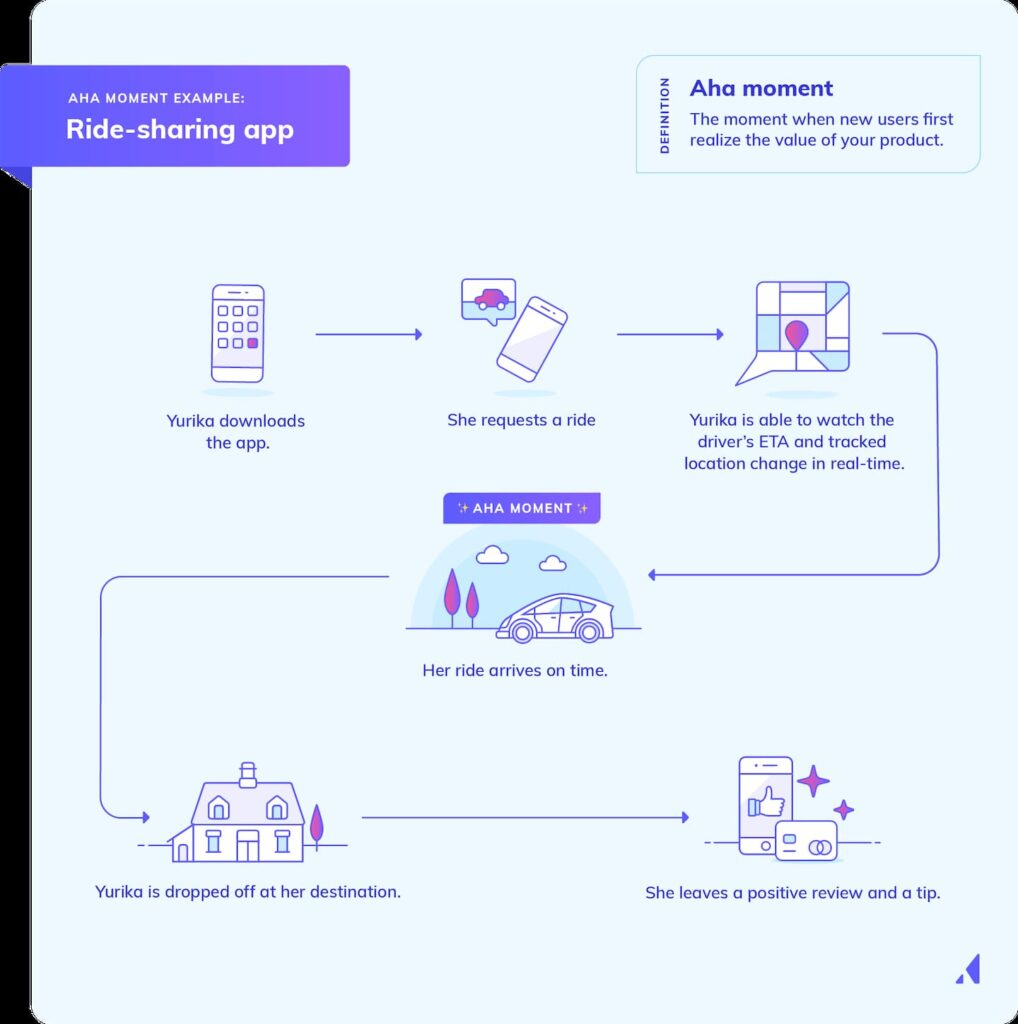
This breakthrough moment is unique to each product or service, so it’s up to the company to identify where it happens and how to guide users towards it.
The first step is understanding your audience, making customer journey analysis a key tool. This process maps out every touchpoint from the moment a user discovers the system to when they become a loyal customer, identifying key interactions that trigger significant shifts in emotions and perception.
The customer journey can be shaped and enhanced using a variety of research tools, including user surveys and interviews, empathy maps, persona modelling, focus groups, card sorting and usability testing, to name a few. Their combined use provides valuable qualitative insights into the real-world applications of the product, allowing for the identification of a specific “Aha Moment” and the implementation of strategies to help users reach it.
Source: Appcues
Strategies to Foster the “Aha Moment”
While different users may take more or less time to reach the “Aha Moment”, here are some strategies to guide them and help them unlock the full potential of the system:
1. Design an Effective Onboarding Experience
The onboarding process allows you to introduce the product and demonstrate how to use it to address various needs, thus playing a key role in its adoption. It should be designed as a simple, accessible and intuitive process that conveys the brand’s values, showcases the interface’s potential and builds trust. This can be achieved through interactive tutorials, in-app messages or tooltips, for instance, while avoiding information overload or overly lengthy and complex explanations.
However, it’s important that the onboarding process doesn’t include the“Aha Moment” itself. This should happen naturally as the user interacts with the product on their own. If forced, it may feel superficial and fail to create a lasting sense of satisfaction or attachment to the product.
2. Showcase the Value Proposition
Once onboarding is complete, the individual should be able to discover the value proposition and experience the “Aha Moment” early on. This is known as “user activation”, and it helps them find a purpose for continuing to use the system in the future.
As the time and effort required to uncover all the benefits of the product or service increases, so does the likelihood of user abandonment. Therefore, it’s essential to make it easy for users to access the key activity defined for the interface. This can be achieved by designing short and concise workflows, offering pre-configured templates or examples, highlighting components that lead to the desired action or automating the most basic, repetitive tasks, for instance.

Source: Subaru
3. Personalise the Experience
While the “Aha Moment” is often the same for everyone, each individual has different needs, desires and abilities. Understanding these allows you to personalise the experience and guide users smoothly towards the loyalty phase, without overwhelming them with options they don’t understand or aren’t interested in. In this regard, it’s important to know whether a user is a beginner or advanced when it comes to similar products, which is why an initial brief questionnaire can be helpful.
Personalised suggestions are one of the most common and effective personalisation tools. They recommend content or features that are likely to be of most interest to the individual, based on their previous interactions with the interface. Other options include creating shortcuts for frequent actions, adding contextual messages to address errors or highlight features they are yet to try, enabling easy adjustments to settings like dark mode, font size or layout and allowing users to seamlessly pick up where they left off in their last session, to name a few.
4. Include Gamification and Rewards
Finally, the incorporation of gamification systems enhances user engagement on their journey to the “Aha Moment”, encouraging exploration of the system and fostering an emotional connection with it. Creating a rewards plan provides extrinsic motivation, driven by the prospect of earning external rewards. When combined with strong intrinsic motivation, where the experience itself is enjoyable or rewarding, it helps integrate the product or service into the individual’s daily life and sustain long-term interest.
There are many ways to implement gamification in an interface, but they all offer immediate positive reinforcement and rewards for completing relevant actions within the system. Common approaches include awarding points, badges or virtual trophies, or can also translate into discounts or physical prizes. Other popular features include level progression and progress bars, as well as leaderboards that allow users to compare their progress with others.

Source: RGC
Whether you’re launching a new product or service and looking for its “Aha Moment” for the first time, or you need to rethink an existing one, our team of experts at GammaUX is here to help. Our design and usability experts will pinpoint the moment that turns users into loyal customers, aligning every effort to make it happen. Shall we have a chat?