


Personalization has become one of the cornerstones of digital experiences. From streaming platforms and ecommerce to digital banking and SaaS products, users expect products to understand their context and help them find what they need with minimal effort.
Yet a growing paradox has emerged. While organizations invest heavily in recommendation engines, predictive models and AI-driven personalization, many users experience interactions that feel repetitive, irrelevant—or even intrusive.
The challenge is no longer the absence of personalization. It’s false personalization.
Personalization Is No Longer a Competitive Advantage
How Netflix, Spotify and Amazon Changed User Expectations
Platforms like Netflix, Spotify and Amazon have set the standard for personalized digital experiences. Users have become accustomed to receiving relevant recommendations, curated content and interfaces that appear tailored to their needs.
As a result, those expectations now extend to virtually every digital product, regardless of industry. Today, users expect their banking app, ecommerce platform or B2B software to understand their context with the same level of intelligence.
More Personalization Doesn’t Always Mean Better UX
Adding personalization by default doesn’t guarantee a better user experience. If recommendations fail to address a real need, arrive too late, or reduce users’ ability to explore, personalization stops adding value and becomes noise.
What Do We Mean by False Personalization?
Before diving deeper, it’s important to distinguish three related concepts:
- Personalization refers to the system adapting the experience based on user behavior, context or needs.
- Customization allows users to actively configure or tailor their own experience.
- Automation enables the system to perform actions automatically, whether or not those actions are personalized.
False personalization occurs when a product appears to adapt to users without actually helping them accomplish their goals or make better decisions. The interface may change messages, banners or recommendations, but the underlying experience remains essentially the same.
Patterns That Reveal Poor Personalization
The System Learns—but Never Unlearns
Effective personalization recognizes that user preferences evolve. When recommendation models continue relying on outdated signals, the experience gradually becomes less relevant.
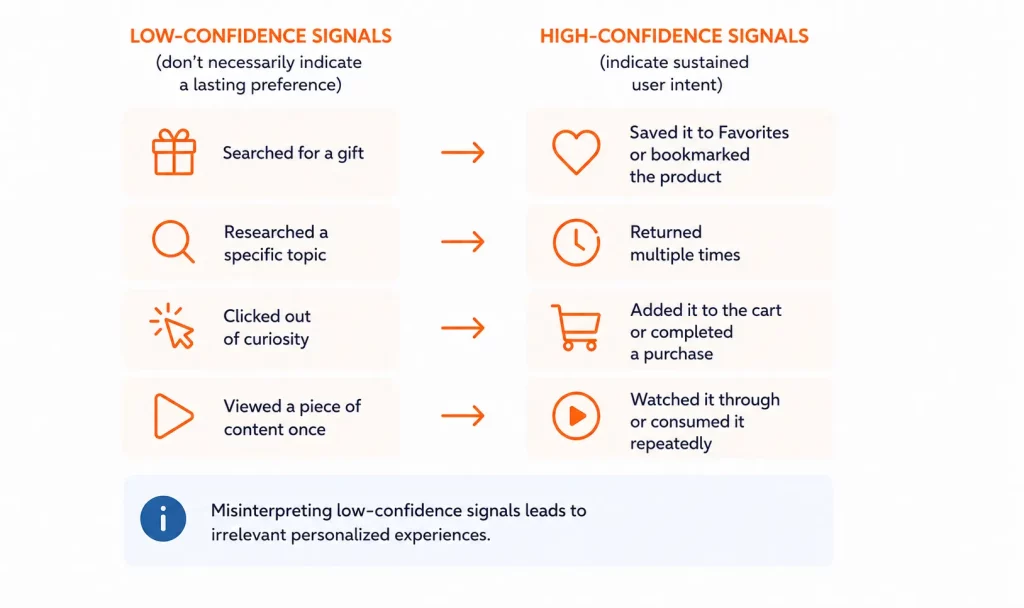
Mistaking a Signal for a Preference
Not every interaction represents a lasting preference. Searching for a gift, researching a topic or clicking out of curiosity shouldn’t permanently reshape the user’s experience.
Personalizing the Interface, Not the Experience
Changing a greeting, banner or CTA may create the impression of personalization, but it doesn’t fundamentally improve workflows, priorities or decision-making.
Algorithms Without a Way to Recover
The best recommendation systems don’t just learn—they also allow users to correct them when they’re wrong.
Examples of False Personalization
False personalization appears across virtually every digital product category.
- Ecommerce: recommending products users have already purchased—or only searched for while buying a gift.
- Streaming platforms: watching one movie or exploring one music genre temporarily reshapes recommendations for weeks.
- Social media: Instagram, TikTok and LinkedIn gradually narrow content discovery into increasingly restrictive filter bubbles.
- SaaS products: “personalized” dashboards where only the greeting changes while every user sees essentially the same information.
- Learning platforms: learning paths determined solely by job titles (“Marketing Manager”, “Developer”) instead of actual learning goals.
- Digital banking: highly personalized commercial offers but very limited personalization when it comes to financial guidance or decision support.
When Personalization Starts Hurting the Experience
Poor personalization doesn’t simply reduce usefulness—it can also erode trust.
When users don’t understand why they’re seeing a recommendation, the well-known creepy effect emerges. When recommendations become overly repetitive, users experience fatigue and lose opportunities for discovery. And when algorithms continuously make decisions on users’ behalf, people begin to lose their sense of control.
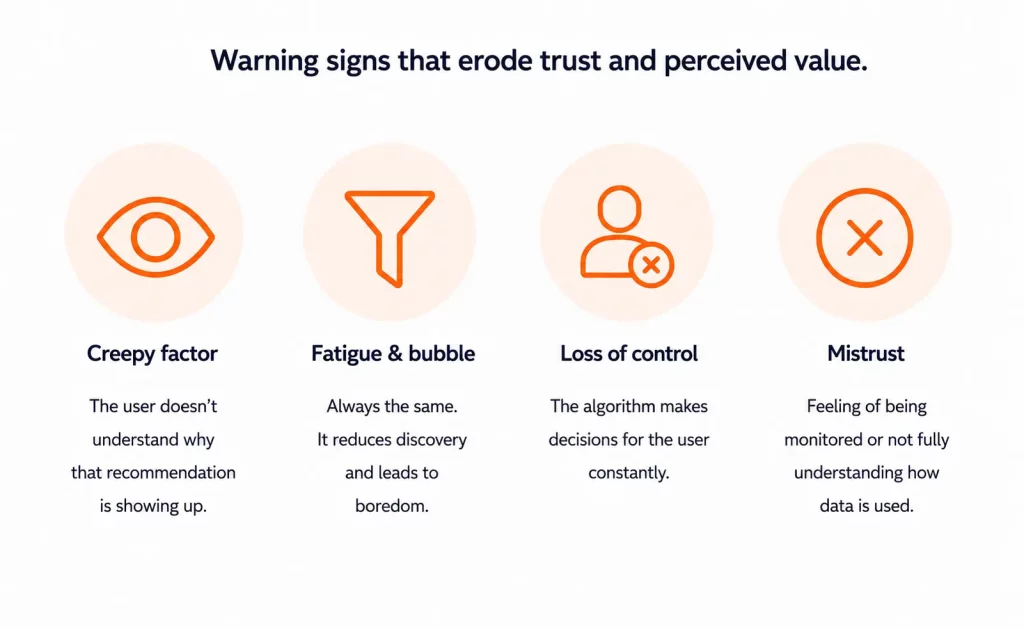
From a UX perspective, personalization shouldn’t only maximize relevance. It should balance relevance, diversity and user autonomy.
Designing Useful and Responsible Personalization
Good personalization isn’t about showing different content to every user. It’s about helping people achieve their goals more efficiently and with greater contextual relevance.
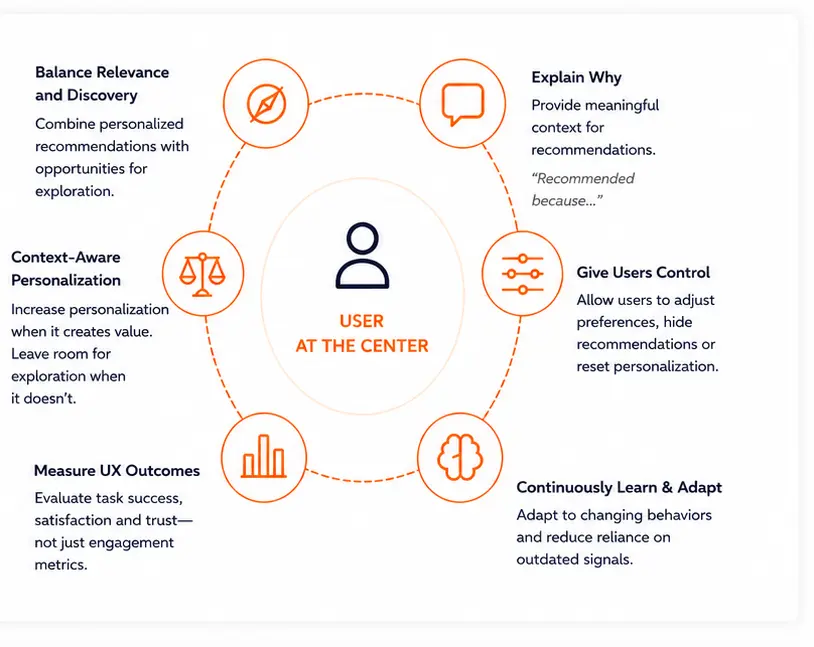
Balance Relevance with Discovery
Showing only what algorithms consider relevant eventually narrows the experience. Effective personalization combines tailored recommendations with exploratory content, helping users discover new products, content or features while avoiding algorithmic filter bubbles.
Explain Why Recommendations Appear
Transparency builds trust. Patterns such as “Recommended because…” or “Based on your recent activity…” help users understand why they’re seeing specific recommendations, reducing perceptions of randomness or surveillance.
The goal isn’t to explain the algorithm itself—but to make its decisions understandable.
Give Users Control
Users should be able to adjust interests, hide irrelevant recommendations or reset personalization when their needs change.
Personalization works best when users can actively participate in shaping it rather than simply accepting whatever the system decides.
Design Systems That Learn—and Unlearn
Preferences evolve over time. Effective systems don’t simply accumulate behavioral data; they gradually reduce the weight of outdated interactions and continuously adapt to changing contexts, goals and habits.
Measure Quality, Not Just Engagement
The success of personalization shouldn’t rely solely on metrics like CTR or time on site. Teams should also evaluate whether personalization reduces effort, improves decision-making, increases satisfaction and strengthens trust.
Design Proportional Personalization
Not every interaction requires the same level of personalization.
For frequent or high-value tasks, deeper personalization can significantly improve efficiency. During exploration or discovery, however, excessive personalization may reduce choice and reinforce existing biases.
The challenge is finding the right balance: personalize when it creates value, and step back when users benefit more from exploration.
A Practical Evaluation Framework for UX and Product Teams
Before implementing any personalization strategy, ask whether it truly improves the experience—or simply introduces additional complexity.
- Does it reduce user effort or add cognitive load?
- Does it respond to the user’s current context or outdated behavior?
- Does it build trust or create uncertainty about data usage?
- Does it encourage discovery or restrict available options?
Beyond metrics such as click-through rate or session duration, personalization quality can also be evaluated through indicators such as:
- Task success: Do users complete their goals more efficiently?
- Perceived usefulness: Do users find recommendations genuinely valuable?
- Recommendation usage: Are recommendations consistently used or routinely ignored?
- Preference adjustments: Do users frequently modify or disable personalization?
- Discovery diversity: Does the system help users discover new content and features, or repeatedly surface the same options?
Collecting these insights requires intentionally designed feedback mechanisms. Patterns such as “Was this recommendation helpful?”, “Not interested”, editable preferences and explicit user feedback not only improve the experience but also provide valuable signals for continuously refining personalization models.
This approach aligns with research from organizations such as Nielsen Norman Group, which has shown that users often struggle to understand and control machine learning-driven interfaces. Similarly, Baymard Institute highlights the importance of designing ecommerce recommendations that reduce friction and support purchasing decisions rather than simply maximizing clicks or product exposure.
If most of these questions cannot be answered confidently—or if users perceive personalization as offering little value—the problem is unlikely to be a lack of personalization. It’s more likely a design problem.
The Best Personalization Provides Context—Not Constraints
Personalization should help people make better decisions, not make decisions for them.
Designing meaningful personalized experiences requires acknowledging that users evolve, their needs change and algorithms sometimes get it wrong. The most effective personalization provides relevant context, respects user autonomy and delivers value without becoming the center of attention.
Ultimately, more personalization doesn’t necessarily mean better design.
At GammaUX, we believe the real challenge is designing digital experiences where technology expands people’s possibilities rather than narrowing them.