


UX debt rarely appears as a single, obvious problem. It tends to accumulate gradually: an unclear validation message, a duplicated component, a flow that grows without review, an exception that becomes a pattern, or a temporary decision that no one ever revisits.
The result is not always a poor experience that is immediately visible. More often, it manifests as something harder to detect: more friction, increased support needs, more inconsistencies, greater effort required to evolve the product, and less trust from users.
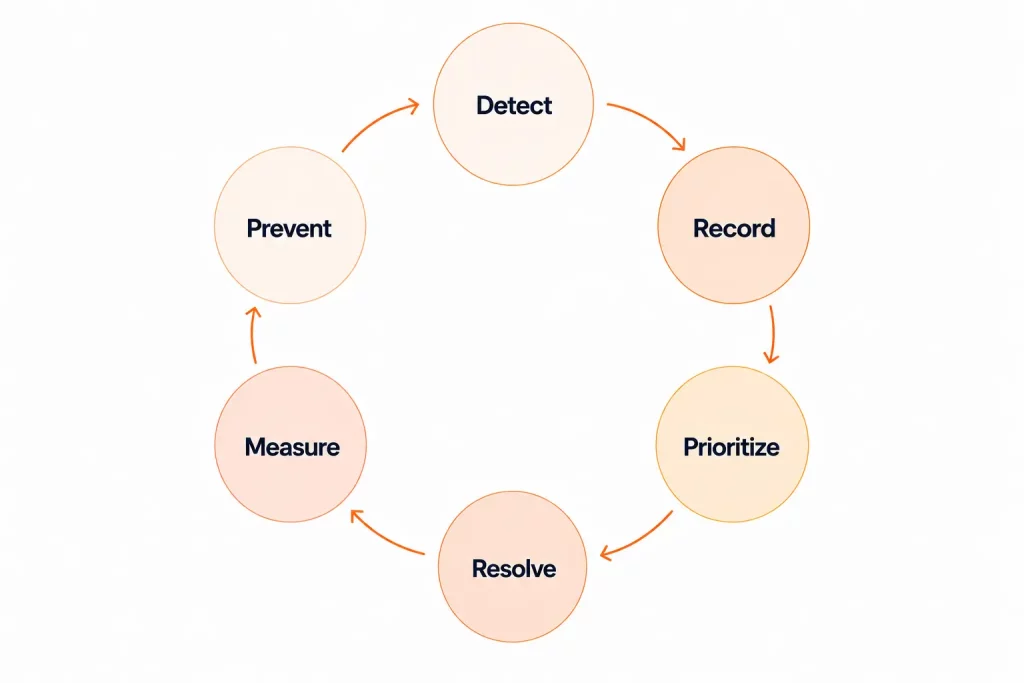
In the long term, UX debt affects more than just the interface; it also compromises the design system, accessibility, product scalability, and the team’s ability to make consistent decisions. That is why it is important to know how to identify, document, prioritize, and resolve it. Let’s take a closer look.
What Is UX Debt and Why Does It Matter?
UX debt is the accumulation of design, content, interaction, or architectural decisions that solve a short-term need but generate a greater cost in the future.
It is not simply a matter of “things that need improvement.” Real UX debt has a tangible impact on the experience: it makes tasks more difficult, reduces comprehension, increases errors, creates inconsistencies, or makes the product harder to maintain.
It can emerge for many reasons: pressure to ship, lack of research, absence of design standards, fragmented decision-making across teams, rapid product growth, legacy system integrations, or a design system that lacks adequate governance.
UX debt matters because it affects three levels:
- Users: more effort, more uncertainty, more errors, and less trust.
- Teams: more rework, more repetitive discussions, and more time required to implement changes.
- Business: lower conversion rates, higher support costs, and reduced capacity for evolution.
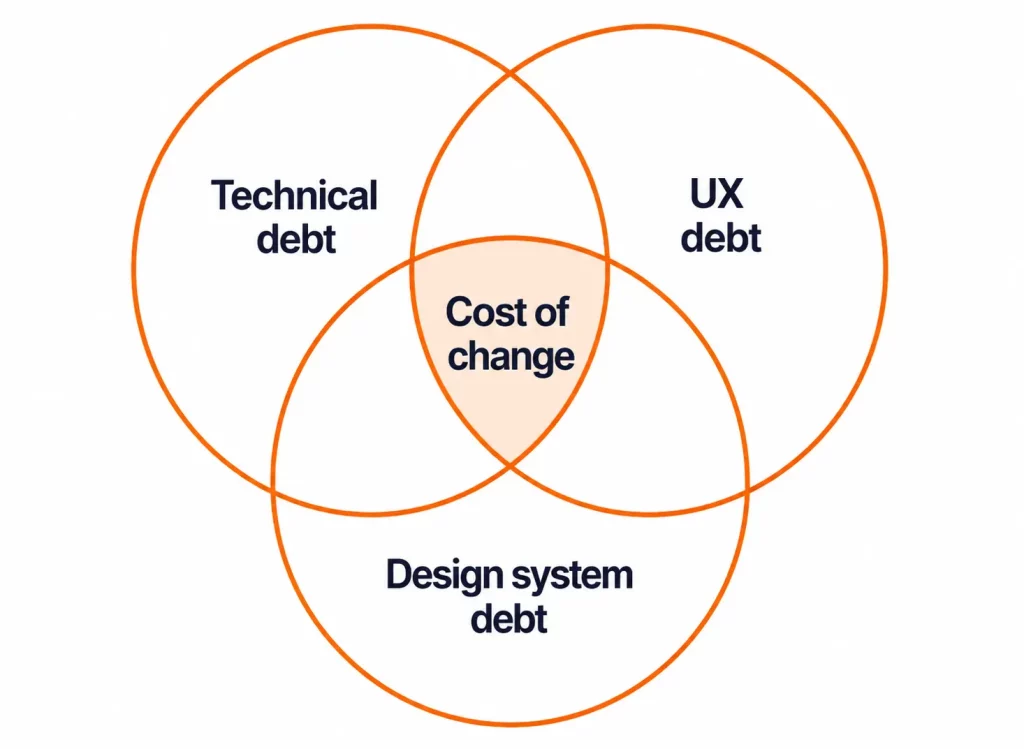
UX Debt, Technical Debt, and Design Debt
UX debt rarely exists in isolation. It often coexists with:
- Technical debt: an inconsistent flow may be caused by different frontend components, or a difficult-to-use form may depend on a rigid technical architecture.
- Design debt: a visual pattern repeated with slight variations may indicate that the design system is not being used, is outdated, or does not cover real-world use cases.
For this reason, treating UX debt as a purely visual issue is often insufficient. The solution requires coordination across Product, Design, Research, Content, Engineering, and QA.
How to Identify UX Debt
Identifying UX debt requires looking beyond the interface. Reviewing screens alone is not enough; teams need to observe flows, metrics, real user behavior, support interactions, accessibility, and overall system consistency.
One strong indicator of UX debt is repetition. When the same issue repeatedly appears in usability tests, support tickets, analytics, or internal conversations, it is probably not an isolated incident but a structural source of friction.
Visible Indicators in the Experience
Some common symptoms include:
- Drop-off at specific steps within a flow.
- Recurring errors in forms or transactional processes.
- Messages that fail to explain what happened or how to resolve it.
- Visually similar components that behave differently.
- Navigation structures that have expanded without a clear logic.
- Tasks that require more steps than necessary.
- Inaccessible patterns or interactions that are difficult to use with a keyboard, screen reader, or touch devices.
Accessibility is particularly relevant. WCAG 2.2 introduces criteria related to visible focus indicators, target size, redundant entry, and accessible authentication, all of which frequently reveal accumulated debt in products that have grown without systematic review. The W3C recommends adopting WCAG 2.2 to maximize the long-term effectiveness of accessibility efforts.
Internal Team Indicators
UX debt can also be detected within the team itself. Common patterns include:
- “We already know this is wrong, but it never gets prioritized.”
- “This component behaves differently depending on the section.”
- “Let’s not touch that flow because it breaks too many things.”
- “We implemented it that way to ship quickly.”
- “Each squad is implementing it differently.”
When these statements become recurring, UX debt is no longer just a perception within the design team. It has become a product governance issue.
How to Document UX Debt
UX debt that is not documented inevitably competes unfairly with new features. Without evidence, ownership, impact, and resolution criteria, it is often reduced to a design opinion.
A useful UX debt log does not need to be complex, but it must be consistent. It can live in the backlog, within a documentation tool, or on a dedicated board connected to the roadmap. What matters is that it enables teams to compare issues and make informed decisions.
What Information Should the Log Include?
At a minimum, each UX debt item should include:
- Problem description: what is happening and why it affects the experience.
- Affected flow: where it appears and at what stage of the journey.
- Evidence: research findings, analytics, support tickets, QA reports, audits, or internal feedback.
- Impacted users: all users, a specific segment, or users with particular needs.
- Frequency: whether it occurs occasionally, repeatedly, or systematically.
- Severity: the extent to which it blocks, confuses, or degrades task completion.
- Business impact: conversion, retention, support, compliance, or efficiency.
- Dependencies: technical, content, legal, design, data, or third-party dependencies.
- Resolution criteria: how the team will know the debt has been resolved.
It is also useful to classify debt by type: deliberate, when consciously accepted; accidental, when caused by misalignment; inherited, when originating from legacy systems; systemic, when affecting multiple flows; or regulatory, when impacting accessibility, privacy, or compliance.
How to Prioritize UX Debt
Not all UX debt has the same level of urgency. Some inconsistencies can wait; others directly affect conversion, accessibility, or user trust.
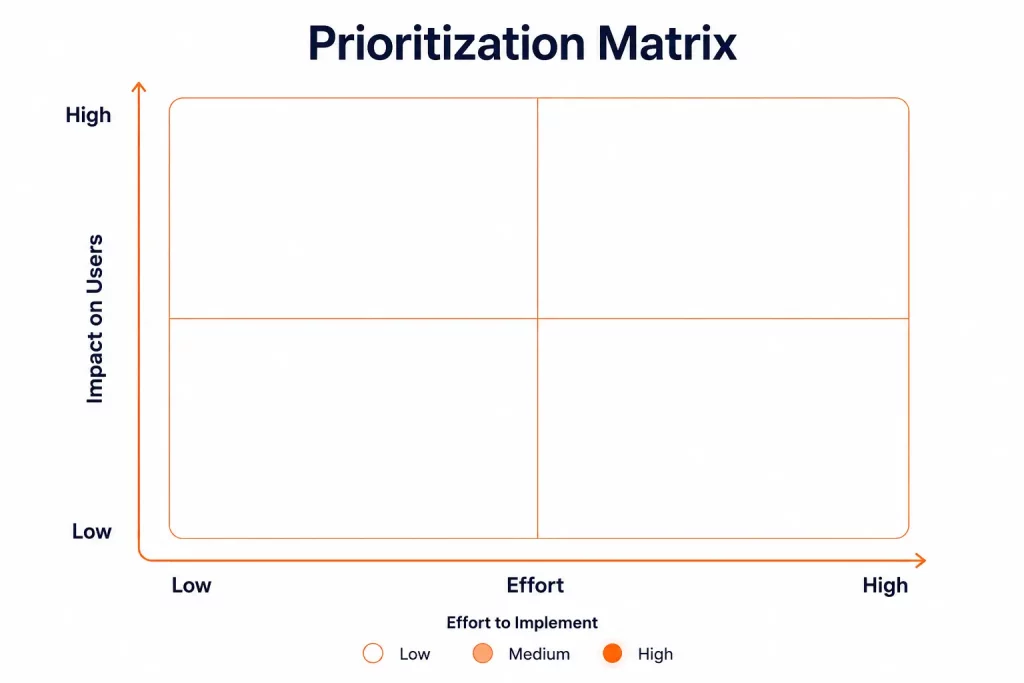
A common mistake is prioritizing solely based on effort. If something is easy to fix, it gets prioritized. If it requires coordination, it gets postponed. While this approach may work for minor improvements, it is ineffective for significant debt. The question should not only be how much it costs to fix, but how much it costs to keep.
Prioritization Variables
A prioritization framework should consider at least six variables:
- User impact: how much it hinders task completion.
- Business impact: its relationship to conversion, retention, efficiency, or support.
- Frequency: how often it occurs and how many users are affected.
- Risk: what happens if it remains unresolved.
- Effort: the investment required to address it.
- Cost of delay: the dependencies and problems it creates over time.
This last factor is critical. UX debt generates compound interest: the longer it remains unresolved, the more decisions are built on top of it. Users learn workarounds, teams document exceptions, support creates alternative responses, and the codebase accumulates dependencies.
When to Prioritize UX Debt Over New Features
A new feature does not always create more value than improving an existing experience. If a critical flow is difficult to complete, optimizing it may have a greater impact than introducing additional capabilities.
For example, before adding a new payment method, it may be more beneficial to address validation errors, pricing clarity, loading states, confirmation messaging, and checkout accessibility.
The key product question is:
💡 Will this new feature create real value, or will it simply add complexity to an experience that is already underperforming?
How to Resolve UX Debt Without Slowing Down the Roadmap
Resolving UX debt does not mean stopping product evolution. It means integrating debt management into the normal way of working.
Debt should not be addressed only through large redesign initiatives. Redesigns may be necessary, but if debt accumulates over years, the cost and risk become significantly higher. A more sustainable approach is to address it continuously through clear criteria and dedicated capacity.
Fix Journeys, Not Individual Screens
A screen may appear correct in isolation while still being part of a poor overall experience. For this reason, it is preferable to prioritize complete journeys: onboarding, search, subscription, checkout, password recovery, account settings, support, or cancellation.
Resolving debt at the journey level helps uncover real dependencies: messaging, empty states, errors, accessibility issues, redundant steps, business rules, and shared components.
It also prevents a common form of false improvement: fixing one screen while simply shifting friction to the next step.
Integrating UX Debt into Sprints, Releases, or Quarterly Cycles
There are several ways to do this:
- Reserve fixed capacity in every sprint for UX and technical debt.
- Include UX debt work in continuous improvement releases.
- Establish quarterly cleanup cycles for critical flows.
- Link UX debt initiatives to roadmap initiatives when they affect the same journey.
- Create specific friction-reduction goals measured through data.
The important thing is that UX debt should not depend on leftover capacity. If it is always addressed “when there is time,” it will never be addressed.
How to Prevent New UX Debt
Prevention is not about avoiding every compromise. Digital products will always involve incomplete decisions, technical constraints, and incremental releases. The key is making trade-offs explicit.
A temporary solution may be perfectly acceptable if it is documented, has a review date, and does not compromise a critical flow. Problems arise when temporary solutions become permanent without evaluation.
Definition of Done with UX Criteria
One effective way to prevent debt is to expand the Definition of Done. It is not enough for a feature to be developed and pass technical QA.
Teams should also verify:
- Consistency with the design system.
- Error, loading, empty, and success states.
- Microcopy and help messaging.
- Minimum accessibility requirements.
- Responsive behavior across devices.
- Tracking required to evaluate performance.
- User validation when the level of risk justifies it.
Within the European context, accessibility is no longer just a best practice. The European Accessibility Act has applied since June 28, 2025, to key products and services including e-commerce, banking, transportation, electronic communications, e-books, computers, and mobile phones, among others. As a result, many accumulated accessibility issues now represent regulatory debt, not merely UX debt.
Governance and Review Rituals
UX debt requires lightweight but consistent governance practices:
- Monthly UX debt reviews.
- Quarterly audits of critical flows.
- Reviews of actual design system adoption.
- Cross-functional sessions involving Product, Design, Research, Engineering, QA, and Support.
- Documented decisions whenever deliberate debt is accepted.
Governance should not become bureaucracy. Its purpose is to reduce ambiguity, avoid duplication, and help teams make better-informed decisions.
Metrics for Measuring UX Debt Reduction
Resolving UX debt should produce observable impact. The effects may not always be immediate, but they should be measurable.
Useful metrics include:
- Fewer errors in forms or critical flows.
- Lower abandonment rates.
- Reduced task completion time.
- Fewer support tickets related to confusion or blockers.
- Improved conversion at key stages.
- Increased reuse of design system components.
- Fewer visual or functional exceptions.
- Better accessibility outcomes.
- Less rework between Design and Engineering.
- Higher satisfaction scores, CSAT, or positive qualitative feedback.
The specific metric will depend on the product. What matters is not measuring UX debt solely through the number of tickets closed. Resolving debt is not about generating more completed tasks; it is about reducing friction, complexity, and future costs.
Conclusion
Product evolution should not be measured solely by the number of features delivered. A product also evolves when it becomes clearer, more consistent, more accessible, and easier to maintain.
UX debt is not an aesthetic problem or a list of pending improvements. It is a reflection of how a product makes decisions under pressure. Identifying, prioritizing, and resolving it enables teams to move forward without degrading the existing experience.
The goal is not to eliminate all debt. The goal is to manage it intentionally: understanding what is being accepted, why it is being accepted, for how long, and with what impact.
At GammaUX, we help product teams identify, prioritize, and reduce friction that affects user experience, conversion, and operational efficiency.