


For years, much of UX Research has been based on a relatively stable assumption: different participants might behave differently, but they interacted with very similar versions of the same product.
Personalization is changing that assumption.
Recommendation systems alter what content each person receives and in what order, adaptive interfaces respond to context or behavior, and AI-powered systems can dynamically generate recommendations, responses, or even elements of the experience itself.
Two people can use the same product and encounter substantially different experiences. Even the same person may receive a different experience tomorrow from the one they receive today.
This creates a methodological challenge for UX Research: How do we evaluate an experience when the experience itself is no longer a stable object of study?
The issue extends beyond Research. If a product team cannot understand why an experience works for some people but not for others, it also becomes harder to identify the source of friction, prioritize improvements, or determine whether personalization is delivering real value.
When there is no longer a single user experience
From one interface to multiple experiences
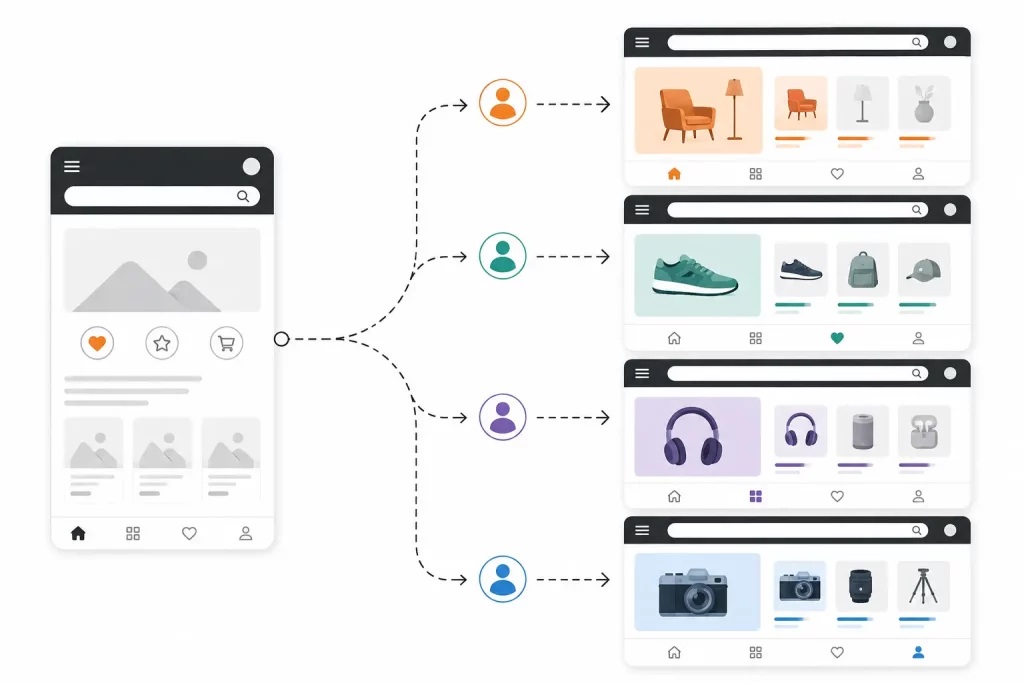
Personalization is not new. Digital products have been adapting content based on preferences, location, purchase history, or behavior for years.
What is changing is the degree, granularity, and dynamism of that adaptation.
A streaming platform can rank hundreds of content items differently for each person; an e-commerce platform can adapt recommendations and offers based on behavioral signals; a financial product can prioritize information based on transactional patterns; and generative AI introduces another variable: it can produce responses or content that did not even exist before the interaction began.
We are therefore moving from relatively deterministic experiences toward experience spaces with multiple possible states and user journeys.
For Research, this introduces a new variable: it is no longer enough to observe what a participant did. We also need to understand what experience they were exposed to and why the system generated that particular experience.
From “Can they use it?” to “Is the system adapting effectively?”
Traditional usability questions remain essential: Is the interface understandable? Can users complete the task? Where does friction occur?
But personalization adds another layer: Is the system making effective decisions about what to show, when to show it, and to whom?
A recommendation may be perfectly understandable and easy to interact with while being completely irrelevant. Conversely, a highly relevant recommendation may be embedded in a confusing or inaccessible interaction.
The scope of evaluation therefore expands: from the interface itself to the relationship between system behavior and user needs.
What does effective personalization actually mean?
Before measuring personalization, we need to define what we mean by quality.
Relevance is an obvious dimension, but it is not sufficient. A system may correctly predict that someone will select a certain type of content again and still fail to help them achieve what they need at that particular moment. Clicks, purchases, dwell time, and selections are observable. Intent, by contrast, is usually inferred.
It is therefore useful to distinguish between personalization that is statistically plausible and personalization that is genuinely useful.
Instead of asking:
Did we get the recommendation right?
we might ask:
Does this adaptation help the user achieve their goal with less effort or make a better decision?
Other dimensions should also be considered, including control, predictability, and transparency. A personalized experience can reduce effort when it aligns with expectations, but it can create friction when users do not understand why something has changed, cannot correct an inaccurate inference, or can no longer find alternatives beyond what the system has selected for them.
What becomes harder to evaluate?
Comparison is one of the foundations of research. Personalization makes comparison more difficult because participants may no longer be exposed to the same stimulus.
If one person receives five highly relevant recommendations while another receives five poor ones, aggregating their results may obscure the most important finding: the system is producing significantly different levels of experience quality.
This does not make comparison impossible, but it changes what we compare.
| Traditionally, we focused on… | With personalized experiences, we also need to consider… |
| Can users complete the task? | Does the adaptation make it easier to achieve their goal? |
| Do users understand the interface? | Do they also understand the system’s behavior when necessary? |
| Where does friction occur? | Does the friction come from the interaction or from the personalization? |
| What do participants do? | What experience was each participant exposed to, and why? |
| Average success or satisfaction | Variability across users, cohorts, and contexts |
| A specific moment of use | How the experience evolves over time |
This distinction is particularly important when separating interaction quality from personalization quality.
If we cannot identify which layer is causing the problem, we may end up redesigning an interface to solve an issue originating in the model, or adjusting the personalization system to compensate for an interaction problem.
Another challenge also emerges: system state becomes part of the research context.
What someone sees may depend on previous searches, purchases, ignored content, location, explicit preferences, or multiple behavioral signals. Knowing that someone failed to find an option may no longer be enough; we need to understand why the product prioritized the options it presented to them.
Measuring personalized experiences
Task completion rate remains useful, but it may no longer be sufficient.
Imagine two people booking accommodation. Both complete the booking. The first quickly finds an option that meets their needs. The second dismisses several irrelevant recommendations, repeatedly adjusts filters, and eventually settles for an acceptable alternative.
According to task completion, both experiences are successful. From a UX perspective, they are clearly not equivalent.
Personalization requires us to consider outcome quality, not merely whether an outcome was achieved.
Depending on the product, we might evaluate:
- perceived relevance;
- effort required to achieve the goal;
- number of corrections or reformulations;
- confidence in the decision;
- system predictability;
- perceived control;
- outcome quality;
- recommendation acceptance or rejection.
But we should not simply replace one average with another. Aggregate metrics can hide groups for whom the experience consistently performs worse. An average conversion or acceptance rate may look positive while specific cohorts receive significantly less useful recommendations.
The more relevant question becomes:
For whom does the experience work, under what conditions, and where is variability concentrated?
This is where UX Research, Product Analytics, and Data Science increasingly need to intersect.
Rethinking UX Research methods
We do not need to replace existing methods. We need to expand how we use and combine them.
Recruitment needs new variables
Two participants with similar demographic profiles may receive entirely different experiences because of their behavioral history.
Beyond age, location, or socioeconomic profile, we may need to consider behavioral and experiential variables: new versus returning users, different levels of available interaction history, people who frequently accept or correct recommendations, or varying degrees of familiarity with the system.
We need to capture the system state that generated the experience
This introduces one of the most significant methodological challenges: reproducibility.
If we observe a problematic recommendation today, will we be able to reproduce the conditions that generated it tomorrow?
Depending on the product, a research session may need to capture not only screens but also elements such as:
- relevant system state;
- interaction history;
- signals influencing the adaptation;
- content or recommendation presented;
- model or experiment version, where relevant.
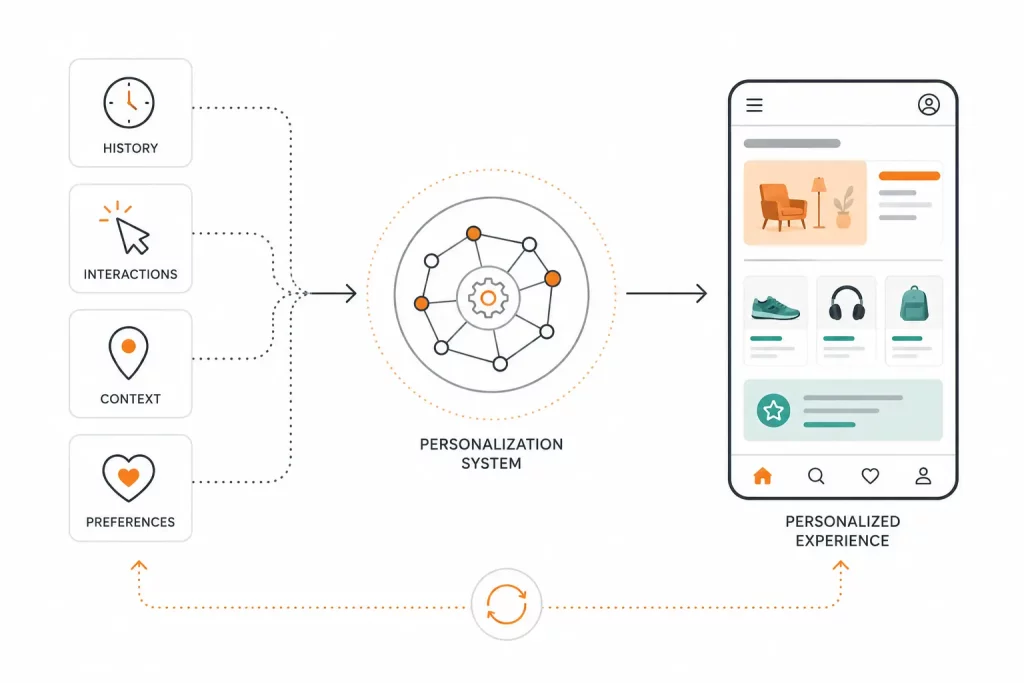
UX Research does not need to become Machine Learning engineering, but it may require enough traceability to connect experience evidence with system behavior.
Combining qualitative and behavioral evidence
The complementarity between methods becomes particularly valuable in personalized experiences.
Analytics may reveal that a particular cohort repeatedly ignores certain recommendations. Qualitative research can help us understand whether those recommendations are irrelevant, repetitive, difficult to understand, or simply unnecessary.
We can think of this as a cycle:
Behavioral signal → qualitative research → hypothesis → experimentation → validation
This shifts Research away from isolated studies toward a more continuous evidence system.
Researching how the experience evolves over time
Personalization also introduces a variable that a one-off usability test is unlikely to capture effectively: time.
An initially poor recommendation may improve as the system learns, while an initially relevant experience may become repetitive if personalization begins to over-reinforce past behavior.
Diary studies, recurring interviews, behavioral cohorts, or experience sampling can help us investigate how the relationship between user and system evolves over time.
Research, experimentation, and analytics are starting to converge
When a product changes continuously, a point-in-time validation inevitably provides only a partial snapshot.
This does not mean that all Research needs to be continuous. It means we can begin to think of evaluation as an ongoing product capability rather than solely as a pre-launch activity.
Experimentation allows us to observe causal effects at scale. Qualitative research contributes something different: an understanding of how those effects are experienced and why they occur.
An A/B test may demonstrate that a recommendation system increases conversion. On its own, however, it cannot explain whether users found better options, whether the increased prominence of recommendations influenced their choices, or whether their confidence in the decision decreased.
Likewise, an interview may reveal an important pattern without telling us how widespread that pattern is across the user population.
The opportunity lies in connecting both types of evidence to answer not only:
Which version performs better?
but:
For whom does it perform better, why, under what conditions, and with what trade-offs?
As personalization increasingly incorporates AI, automated evaluation will also play a growing role. However, model performance and experience quality are not equivalent.
A recommendation can be statistically relevant yet inappropriate in context; a generated response can be correct but delivered at the wrong moment; an adaptation can reduce the number of clicks while simultaneously making the system less predictable.
Human evaluation remains essential for understanding meaning, context, expectations, and consequences.
A new role for UX Research
The interface remains important, but increasingly it may represent only the visible output of a system composed of behavioral data, rules, experiments, models, and adaptive logic.
This expands the scope of UX Research. It does not mean turning Research into Data Science or model evaluation, but rather broadening how we understand the relationship between people and products.
What changes is the scale of that relationship: the object of research may no longer be only a relatively stable interface, but also a system that determines what experience to create, for whom, and under what conditions.
That is why one of the most useful questions when evaluating personalized products may be:
For whom does this experience work, under what conditions, why does it work, and what happens as the system evolves?
Answering this requires combining usability, qualitative research, behavioral data, experimentation, and longitudinal analysis.
For UX Research, this means more than simply adding new techniques. It means expanding the discipline so that it can generate evidence about products whose behavior varies across users and changes over time.
As personalization and AI make these products increasingly dynamic, understanding that variability may become one of UX Research’s most valuable contributions to product decision-making.
At GammaUX, we are already working through these challenges alongside product teams, combining research, behavioral data, and continuous evaluation to understand how personalized experiences perform, who they create value for, and what evidence we need to keep improving them.